

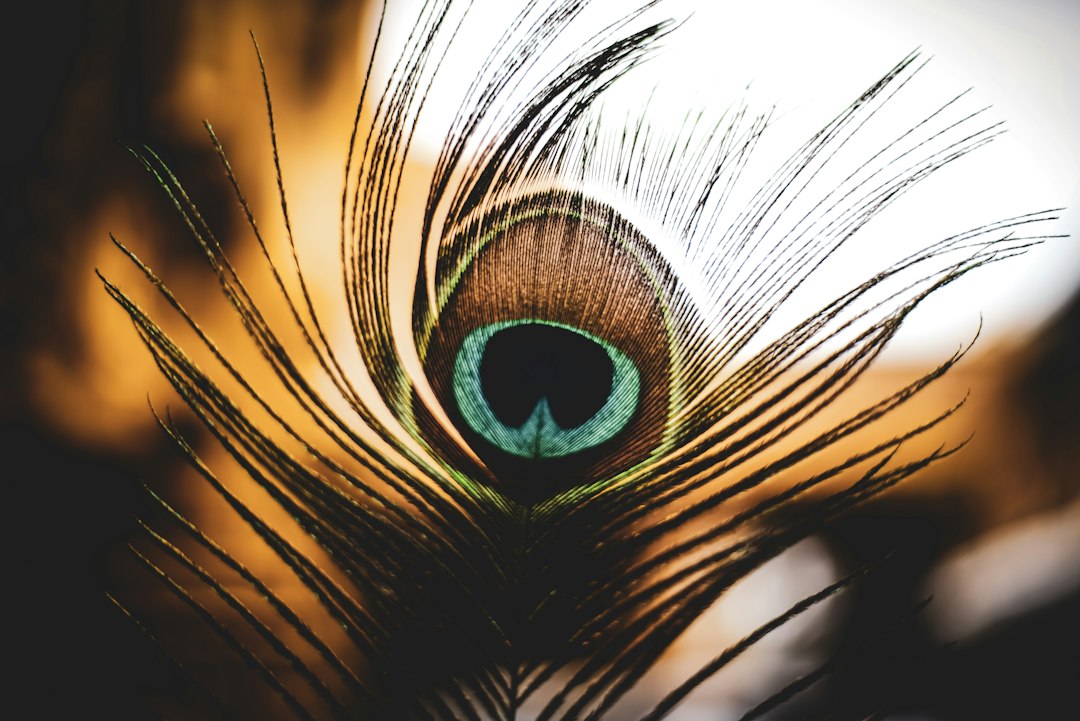
Peacock feathers, renowned for their vibrant iridescent hues, are not only a feast for the eyes but also harbor an impressive technological potential. Recent scientific investigations have unveiled that these feathers are capable of emitting laser beams under certain conditions, propelling them from the realm of natural wonder to scientific marvel.
Traditionally celebrated in cultural and artistic landscapes for their mesmerizing beauty, peacock feathers owe their distinctive color palette to the microstructure of their barbules, which are part of their intricate feather architecture. This microstructural organization is responsible for the spectral qualities that cast such a spell over observers, offering a living demonstration of light manipulation within nature.
The leap from beauty to laser emission is facilitated by the unique structural properties of peacock feathers. Upon closer inspection, it is revealed that these feathers contain nanoscale structures. These structures can potentially act as ‘natural laser resonators’. By harnessing the photonic crystal cavity found within these structures, light is intensified and emitted in a coherent form similar to a laser.
This innovative discovery stems from extensive research into photonics, the branch of technology concerned with the transmission and detection of light. Researchers suggest that when peacock feathers are stimulated under specific environmental conditions, their nanostructures are able to amplify light signals – an intrinsic property leveraged in laser technology. Although still in its exploratory phase, this finding opens up possibilities for using biological systems to develop new types of lasers.
In the current technological landscape, lasers are indispensable, applied in everything from intricate surgical procedures to communications and even entertainment. By understanding how peacock feathers can naturally perform light intensification, scientists are inspired to replicate these mechanisms in synthetic forms, offering sustainable and energy-efficient light technologies.
Beyond their immediate technological allure, these findings about peacock feathers could also have profound implications for developing bio-inspired optical devices. By studying the photonic properties of peacock feathers more closely, new avenues may open for advances in fields such as biomimetics and energy efficiency. As such, the simple yet complex peacock feather serves as both muse and model for future technologies.
The practical applications of this discovery could be far-reaching. With ongoing advancements in the manipulation of light at the nanoscopic level, peacock feathers could serve as a blueprint for novel optical devices that require minimal energy input and yet deliver powerful results. These could range from better displays in smart devices to more efficient data transmission systems.
Furthermore, the peacock’s ability to naturally harness and emit laser-like light could inspire new intersections between biology and technology. By unlocking the principles governing this natural phenomenon, engineers and scientists can pave the way for new forms of electronic design and materials science, potentially leading towards groundbreaking product developments that are more aligned with sustainable practices.
Understanding peacock feathers’ laser emission capabilities doesn’t just serve technological ambitions. It deepens our appreciation of nature’s ability to achieve complex functionalities through intricate design. The fact that such beauty houses the power for scientific innovation underlines the mysterious yet systematic codes embedded within natural phenomena – a reflection of the seamless blend of art and science in creation.
Smart Life
Peacock Feathers











Leave a Reply